

01 / The introduction
A business can help answer the question and still miss the introduction.
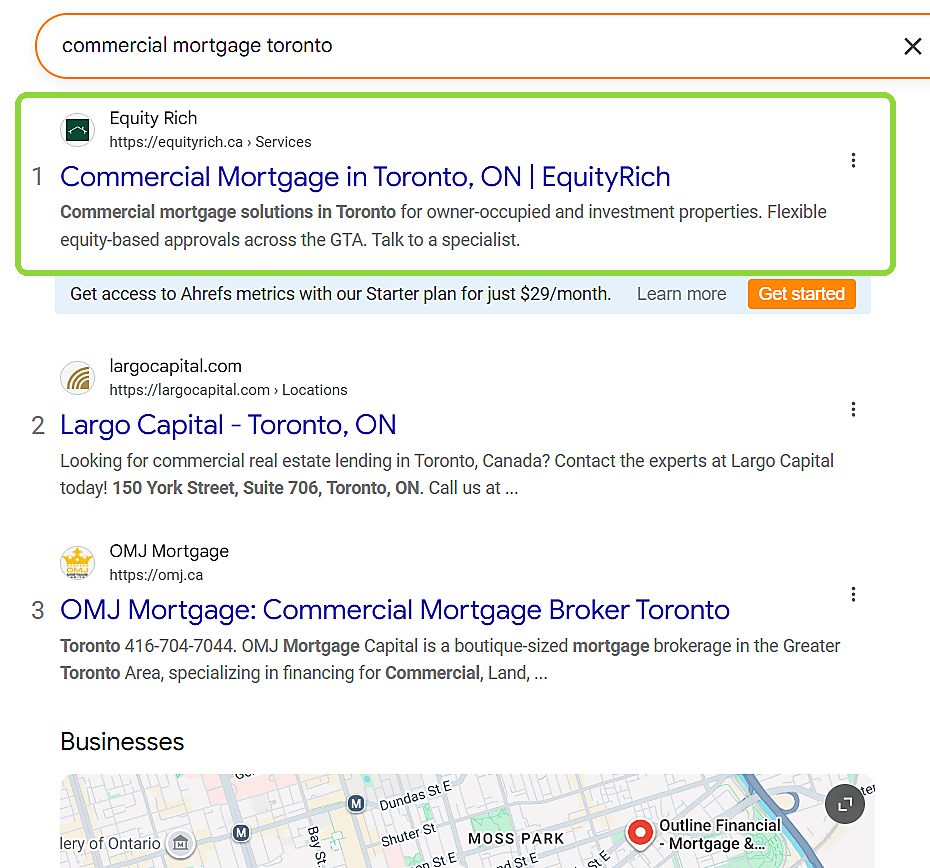
The search is only three words: “commercial mortgage toronto.” In one Google screenshot, EquityRich occupies the first visible organic result. There is the company’s name, a blue link and a few lines describing its offer. Anyone interested can step through that small doorway into the company’s own account of itself.
This is the familiar arrangement behind search engine optimisation, or SEO: make a useful page discoverable for a relevant search, then give the person who arrives a reason to stay. The results page—often shortened to SERP—helps the searcher choose where to go. The business gets a chance to make its case.
From the archive
The familiar introduction
A second capture, for the same words, shows a more complicated introduction. Google has written an answer of its own. EquityRich appears in a supporting source card, but the company named in the visible answer is CMLS Capital. A reader could take in the explanation, remember the name in the paragraph and never investigate the source beside it.
The captures were made on different dates, and the second even shows Kansas as its location context despite the Toronto query. They are observations, not a controlled comparison. Their value is more basic: they make a distinction visible. Being used as a source and being introduced as a business are separate events.
From the archive
The source and the named business
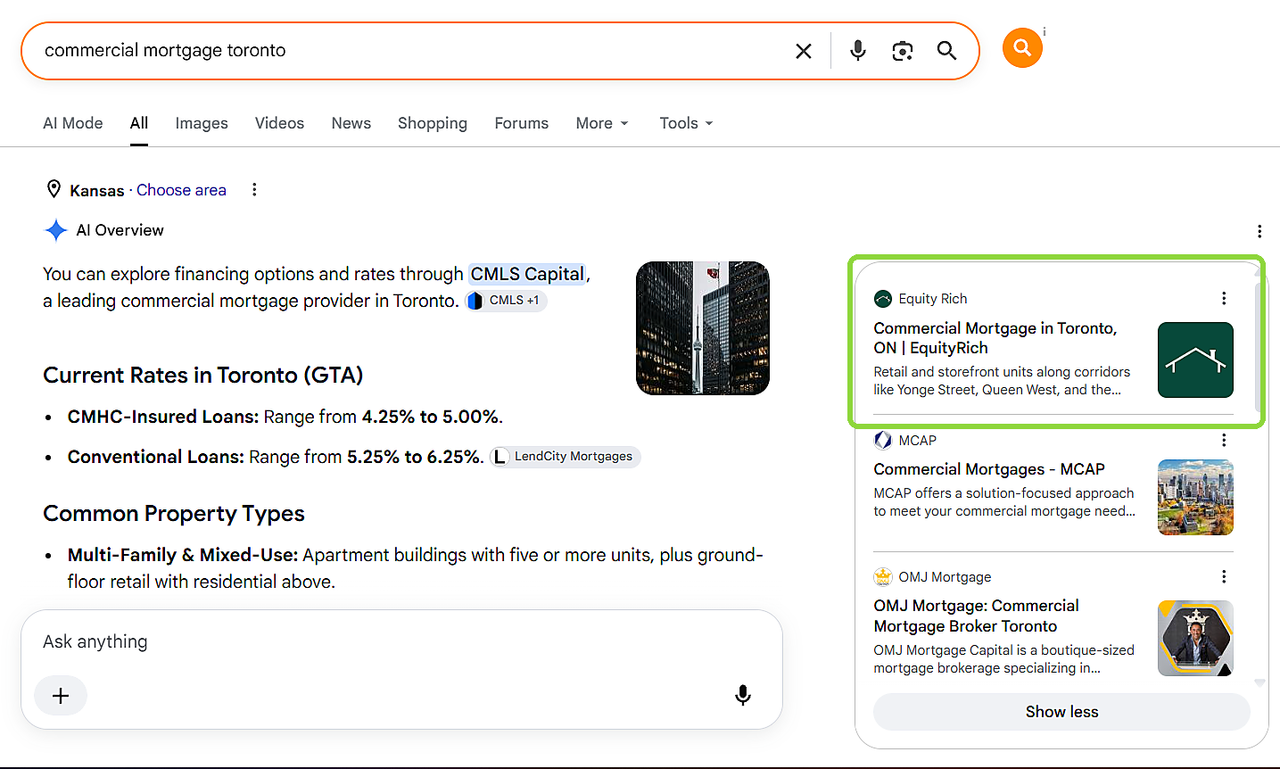
For an owner paying to be found, that separation deserves attention. A company can contribute useful knowledge without receiving the visit it hoped to earn. It can also be named in an answer and gain an introduction that a website report never records. Neither possibility tells us what happened to sales. Both complicate the old habit of treating traffic as a complete account of discovery.
This is the change worth understanding beneath the acronyms and the confident predictions. Search is acquiring more of the work that happens between having a question and choosing whom to trust. The customer may still reach your website. By then, some of the conversation may already be over.
02 / The conversation
The answer becomes a place to spend time.
Consider a homeowner planning a kitchen renovation. This is an imagined example, but the questions are ordinary enough: what will it cost, which expenses tend to surprise people, and can the family live in the house while the work is done? Those questions precede the search for a contractor. They help the homeowner decide what kind of contractor to look for.
A set of links leaves much of that investigation to the reader. They open pages, compare claims and carry what they learn from one website to the next. A generated answer can gather an explanation in one place. A follow-up question can narrow it: suppose we keep the existing layout; suppose the house is a century old. Research starts to resemble a conversation.
Explained visually / illustrative diagram
One buying decision. More than one route.
“What would renovating my kitchen involve?”
Website-led research
See search results
Open a business website
Read explanations and inspect projects
Answer-led research
Read an AI explanation
Ask follow-up questions
Follow a source, search a company name, or stop
A website visit, call or enquiry may happen later.
The appeal is easy to understand. The reader gets to ask the question in the shape it has in their life. The trade-off is quieter. Someone—or, here, a system—has chosen which details to include, whose explanation to draw on and which names deserve space. Convenience gives those choices influence.
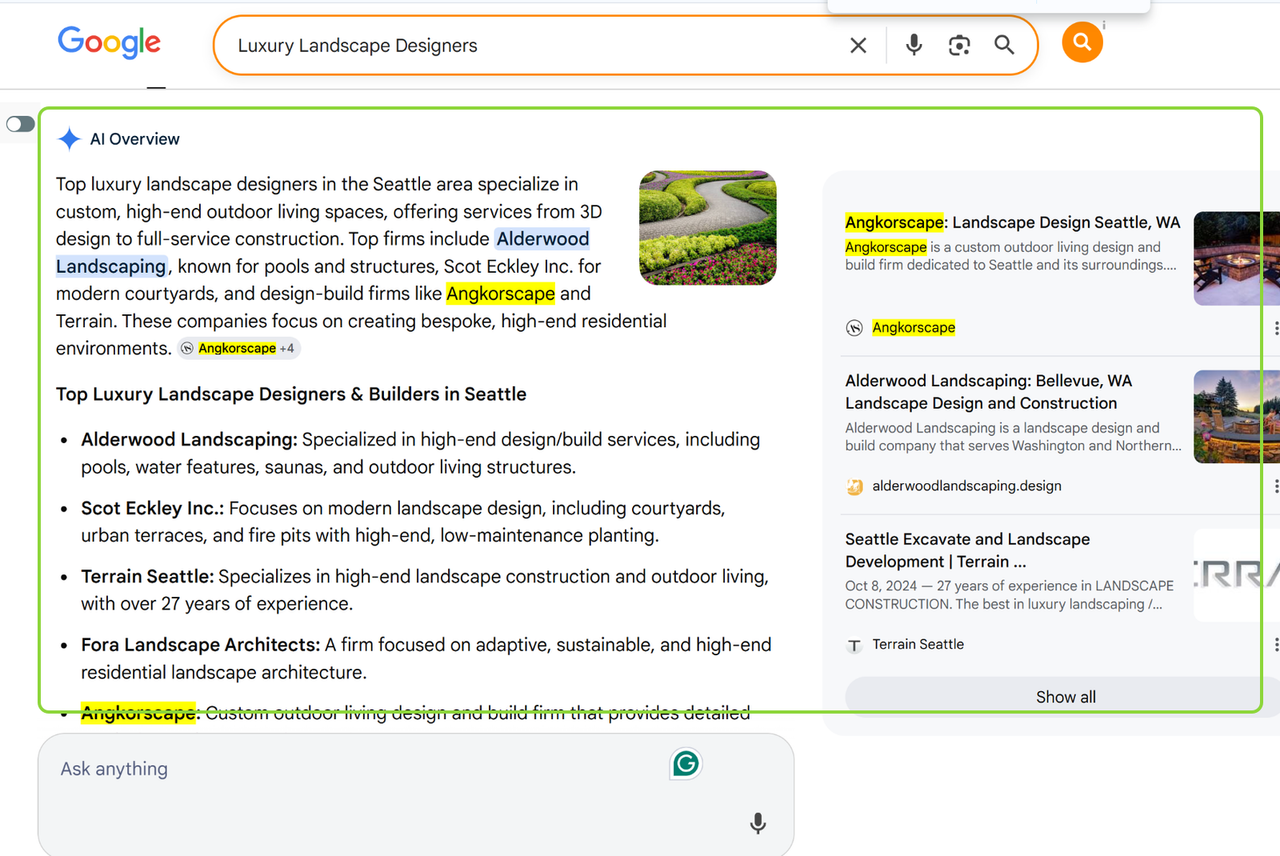
Google’s AI Overview puts a generated response inside the search experience. Look at the landscape-design capture below: Angkorscape appears in the answer and in a source panel. Unlike the mortgage example, the business receives a visible mention as well as a citation. The useful question is what role a company plays in the response, not simply whether its website appears somewhere on the screen.
From the archive
An answer with room for a business name
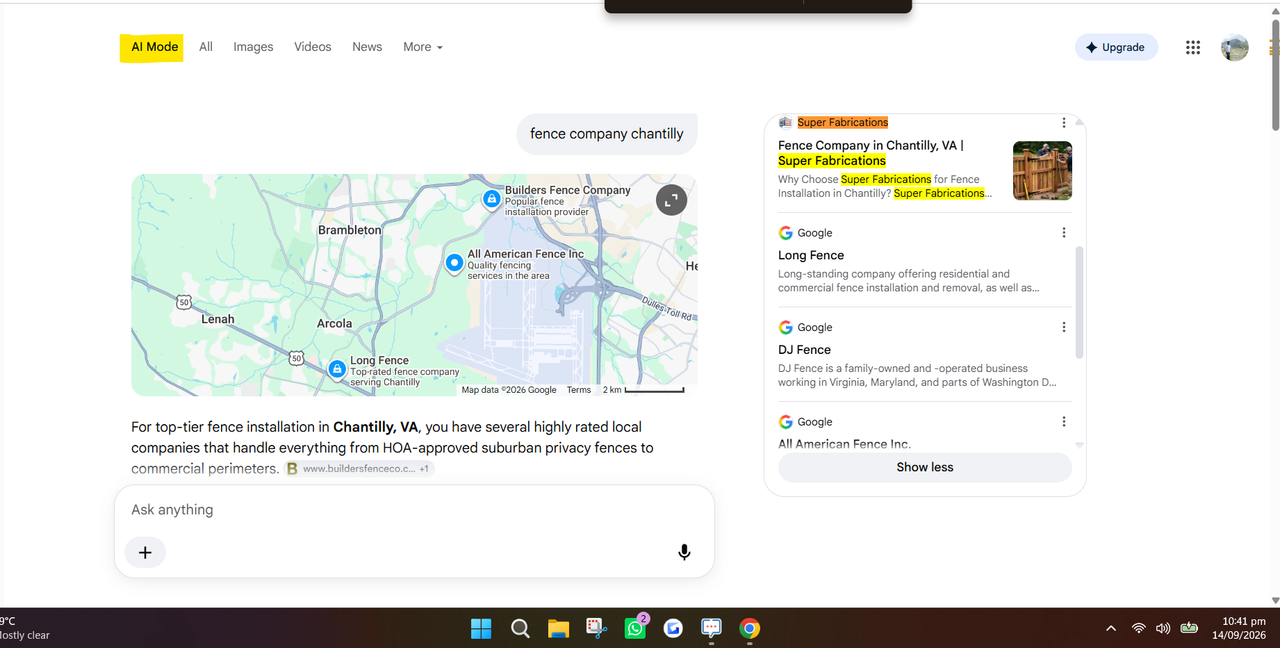
AI Mode makes room for a longer exchange. The capture below includes an answer, a map, sources and a field for the next question. Google explains that its AI search features may run related searches while assembling a response. A customer’s single question can therefore lead the system through more than one underlying search. Google describes how these features work.
From the archive
A place for the next question
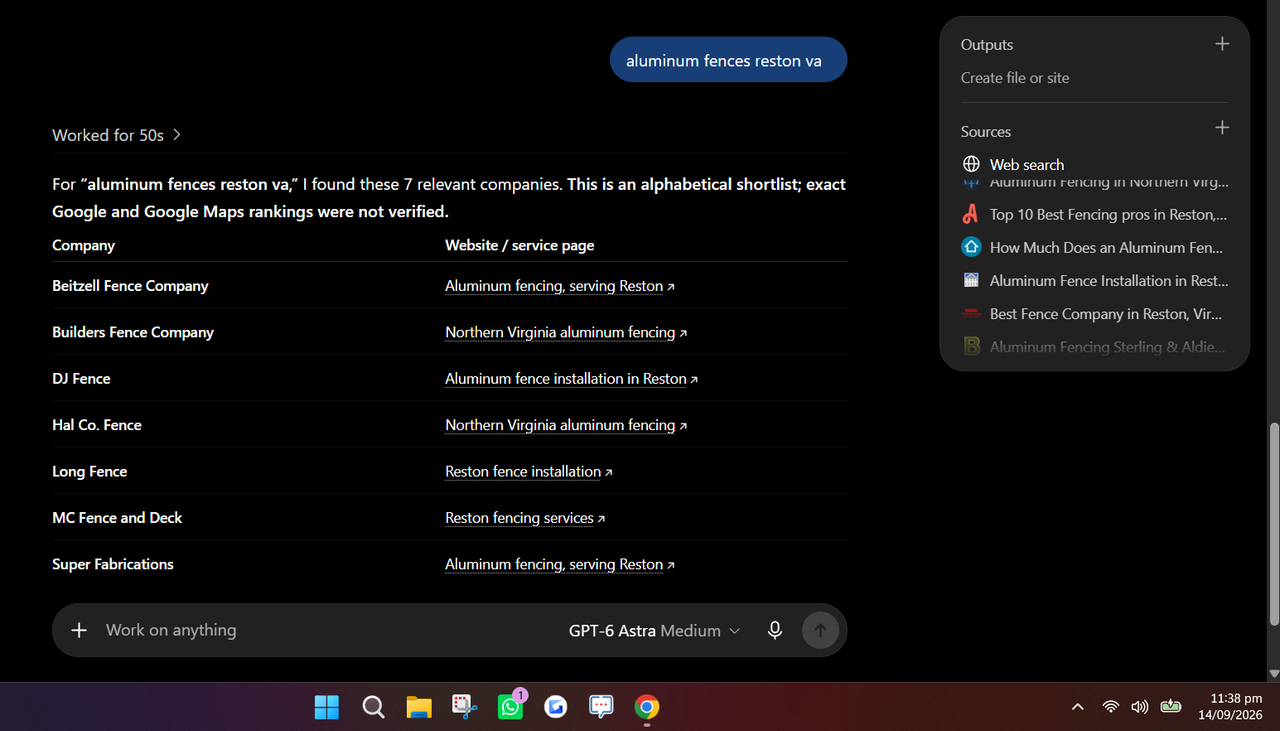
ChatGPT search offers another setting for this kind of investigation. In our fencing example, it has organised businesses into a shortlist and supplied links. The list explicitly says it is alphabetical: the last company has not “ranked seventh” in the familiar SEO sense. Reading the answer closely changes what can honestly be claimed about it.
From the archive
A shortlist is not a league table
The vocabulary has followed the interfaces. AEO, or answer engine optimisation, describes work intended to help information appear in answers. GEO, or generative engine optimisation, focuses on visibility in generated responses. In practice, the terms overlap. They describe ambitions more neatly than they describe separate systems you can switch on.
SEO remains the foundation beneath much of this work: helping search engines access and understand pages, and making those pages useful for the searches they serve. Google’s introductory guidance sets out that basic job. The newer terms are useful when they sharpen a question—are we being cited, named or recommended? They become less useful when they make a familiar service sound newly mysterious.
For our hypothetical renovator, the practical problem is wonderfully concrete. Does the business have anything worth drawing on when a homeowner asks about an old house, a tight budget or the mess of living through construction? A slogan about quality leaves little to work with. A detailed account of an actual project gives both the homeowner and a search system something more substantial to examine.
03 / The missing visit
What becomes of the click?
There is a moment in any search when the person has enough. Enough to identify a material, understand a phrase or decide that a project is more expensive than expected. If an answer supplies that stopping point, opening a website becomes optional.
The concern for businesses is that the visit they used to earn was sometimes a by-product of delivering the explanation. The reader came for an answer and, along the way, encountered the company. An answer delivered on the results page can satisfy the first need while removing the occasion for that encounter.
Pew Research Center studied the browsing activity of 900 U.S. adults in March 2025. In searches classified as displaying an AI summary, users clicked a traditional result on 8% of visits, compared with 15% when no summary appeared. Clicks on links inside the summary occurred on just 1% of visits with a summary. The study was published in July 2025.
01 / TRADITIONAL-RESULT CLICKS
With an AI summary, fewer visits led to a click.
Share of search-page visits · Axis: 0–20%
Those figures give the concern weight, but they need their setting. This was observed behaviour, not an experiment assigning identical searches to two different screens. Pew collected the result pages in April, after the browsing period. The searches with summaries could also differ from those without them. The comparison describes a pattern; it does not isolate the summary as the sole cause.
Ahrefs approached the question from another direction. Its February 2026 analysis compared desktop data for 300,000 keywords across December 2023 and December 2025. It used the decline among keywords without AI Overviews to estimate what click-through might otherwise have been for those with them. For the top-ranked page, the observed rate was 58% below that modelled baseline.
TOP-RANKED PAGE CLICK-THROUGH
58%
lower than the modelled baseline
The observed click-through rate was about 42% of the estimated level without the AI Overview effect.
Modelled baseline100
Observed relative level42
Index: baseline = 100. These bars are not raw click-through percentages.
The important word is “modelled.” This is an estimate built from a comparison, not a meter measuring how much traffic AI removed from your business. Its practical implication is nevertheless serious: a high organic position may earn a different share of attention when the page around it changes.
There is no single business experience concealed inside these averages. Someone looking up a definition may finish immediately. Someone choosing a contractor for a large project may keep investigating long after reading a summary. Both are searches; the economic meaning of their clicks is different.
That is why a blanket promise about replacing lost traffic with AI visibility deserves the same scrutiny as a blanket prediction of collapse. The useful work begins with the particular questions your customers ask—and with knowing which visits were valuable in the first place.
04 / The misleading average
A report can look worse while showing you more.
Search reports have a peculiar talent for making a complicated situation look settled. One number rises, another falls, and a colour supplies the verdict. Green feels like progress. Red asks for an explanation.
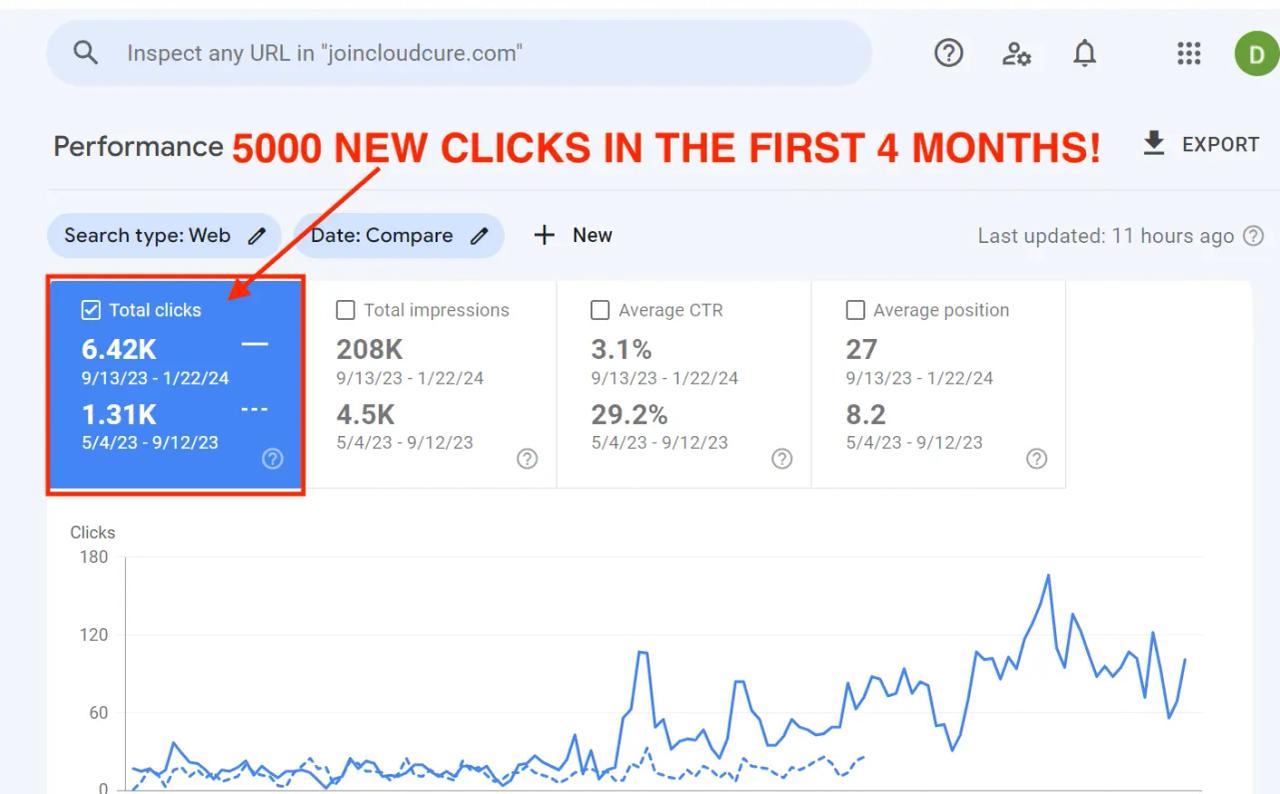
Take the historical report below, from the CloudCure case study. Clicks rose from roughly 1,310 to 6,420. Impressions climbed from about 4,500 to 208,000. Yet click-through rate fell from 29.2% to 3.1%, and average position moved from 8.2 to 27. A reader looking only at the last two measures could mistake a much larger search presence for a simple retreat.
From the archive
More visits, a lower click-through rate
An impression records an appearance of a link under Google’s counting rules; it is not proof that a person noticed or remembered the business. A click records someone following a link. Click-through rate, usually shortened to CTR, divides clicks by impressions. Average position summarises where results appeared, with rules that vary across search features. Google explains the definitions and counting rules.
The arithmetic in this report is revealing. The smaller period produced about 29 clicks for every hundred impressions. The larger one produced about three. But those three came from a vastly larger pool, so the total number of visits grew. The rate fell as the volume rose.
That does not explain why the pool changed. One possibility is that the site began appearing for many more searches, including ones where it occupied lower positions. Establishing that would require the underlying query and page data. The screenshot alone gives us the totals, not the history that produced them. These historical totals tell us nothing about an AI-search effect; this is a lesson in reading a report.
Now consider a different set of numbers. A site earns 400 clicks from 10,000 impressions. Later, it earns 300 from 20,000. Twice as many impressions, fewer visits. The result can be perfectly real without telling us whether the business is becoming easier for the right people to find.
Worked example / invented numbers to explain the maths
Twice the exposure. Fewer visits.
Period A
10,000
impressions × 4% click-through
400 clicks
Period B
20,000
impressions × 1.5% click-through
300 clicks
If the additional impressions concern services the company cannot supply, their commercial value may be slight. If the lost clicks came from a valuable service page that slipped behind competitors, the loss deserves attention. If positions stayed similar but an answer began satisfying the question above the links, the explanation may lie in the results page itself. An aggregate graph cannot choose among those stories.
Explained visually / illustrative diagram
The same headline numbers can hide different problems.
Investigate the searches and pages behind the total
New topics or locations contribute impressions.
New versus existing query groups and their relevance.
The total hides weaker service-page performance.
The same important pages, queries and periods.
An answer or another feature changes the experience.
Affected results and whether rankings also changed.
The investigation is to compare like with like: the same important services, locations, pages and groups of queries over sensible periods. Separate searches for your name from searches by people who have not chosen a provider. Look at the screen those customers actually encounter. Then bring in whatever you know about the enquiries and customers the visits produced.
This is where impressions become more useful—and where it is easiest to ask too much of them. They can expose growing reach that clicks alone miss. They can help locate a change in attention. They cannot tell you that a mention persuaded someone, that a citation was read or that an enquiry will arrive later.
Google includes traffic from its AI search features within Search Console’s Web reporting. An increase in that report therefore does not, by itself, identify which impressions came from AI answers. Google documents this reporting scope. A screenshot of a citation is a separate observation, not a missing column you can simply add to the graph.
Explained visually / illustrative diagram
What each layer can tell you
01 / VISIBILITY
A relevant search appearance
Evidence: impressions, rankings and dated answer observations.
↓ An appearance does not prove a response.
02 / RESPONSE
A visit, call or enquiry
Evidence: measured actions and what the prospect tells you.
↓ An enquiry does not prove a qualified customer.
03 / BUSINESS OUTCOME
A suitable opportunity or sale
Evidence: qualification, customers and attributable revenue.
For a business, visibility, response and revenue belong in the same conversation. They answer different questions. Visibility concerns the chance to be encountered. Response shows someone doing something with that opportunity. Revenue tells you whether the work eventually supported the business, insofar as you can trace it. Keeping the distinctions intact makes the report more useful than declaring any one of them the new king.
05 / The useful detail
What can a customer learn that only you could tell them?
Return to the renovation company. Almost any competitor can publish an article listing the advantages of a new kitchen. The owner has access to a different kind of knowledge: what happened when a wall came down on a particular job; why a proposed layout changed; which decision saved money and which apparent saving proved expensive.
A project account built from those facts does several jobs at once. It explains a problem a homeowner might recognise. It gives the reader evidence of how the company thinks. It supplies detail that can be checked against photographs, specifications or the people involved. Even a reader who disagrees with the decision has learned something useful about the business.

The principle travels, although the evidence changes. Imagine an electrician explaining an EV-charger installation. “We install chargers” establishes the service. An account of the site assessment, equipment and limits of the job helps a customer understand what an installation involves. The company should explain the work it actually performed; it need not pretend every house will present the same conditions.
For an accountant, the useful detail might be how an engagement works: which records the client needs to supply, where responsibility changes hands and what the quoted fee covers. For a specialist retailer, it might be a comparison of two products using published specifications and firsthand observations, including the circumstances in which the cheaper one is sufficient.
These are examples of what to document, not claims that any particular page will secure an AI mention. Their value begins with the customer. They replace the demand to trust a company’s adjectives with material a person can inspect.
This also explains why producing more pages can feel busy while adding very little. A tenth account of the same general advice does not automatically answer the question the first nine avoided. The more useful editorial question is: what does a person need to understand before making this decision, and what evidence do we have that would help them understand it?
For a smaller business, that question has an encouraging answer. You may not possess a national brand’s resources. You do possess the particulars of your own work. Treating those particulars seriously is a more credible starting point than trying to sound authoritative about everything.
06 / The work underneath
The new language still needs something solid beneath it.
Useful evidence must also be accessible. A careful project account hidden behind a broken page, an unexplained service or an inaccessible image cannot do its full job. This is where the technical and editorial sides of SEO meet: the business needs to make its information available and give that information a coherent meaning.
Google says a page must be indexed and eligible to appear with a snippet to be a supporting link in its AI features. It does not require special AI markup or a new machine-readable file for that purpose, and eligibility does not promise selection. Its guidance is explicit about those requirements.
That makes a sensible first examination fairly concrete. Can the important pages be reached and understood? Do they accurately describe what the business offers, where it operates and what supports its claims? Are useful explanations attached to the relevant services, or stranded in an unrelated corner of the site? The answers identify actual work rather than a package of new terminology.
The same care should apply to machine-written material. Generative tools can help organise and express knowledge, but fluent prose is easy to produce without adding knowledge at all. Google’s guidance warns against generating pages at scale without value for users. Its advice concerns the usefulness of the result. For the owner commissioning the work, the immediate test is simpler: what did this page teach a prospective customer that our existing pages did not?
Observing AI answers should be equally disciplined. Choose a manageable set of real buying questions and record the platform, wording, date and relevant location or conversation context. Save what was shown. Distinguish a link used as a source from a business named in the answer, and both from an explicit recommendation. Repeat the observations rather than turning a favourable screenshot into a permanent claim.
ChatGPT search can use context, including approximate location, when producing results. OpenAI also describes how its search crawler relates to website eligibility. Its documentation is a useful starting point. Those details matter when two people ask apparently similar questions and see different answers.
The resulting record will be incomplete. It can still be useful: a description that is consistently wrong deserves investigation; a valuable service that is poorly explained deserves better material. A handful of searches cannot stand in for the experience of every possible customer.
07 / Back to the business
Ask for an explanation you can use.
The next SEO meeting need not begin with a prediction about the future of search. Begin with a part of the business you want to grow. Put the relevant pages, search results and enquiry evidence on the table. Ask what a prospective customer can learn, where the company is being encountered and what remains unknown.

There should be room for an honest mixed result. Perhaps more people can find a service, but the enquiries are poorly matched. Perhaps visits have fallen while qualified enquiries have held up. Perhaps an AI answer names the business, but nobody can yet connect that appearance to a customer. Each situation calls for a different next step. None improves when uncertainty is concealed behind a larger number.
Agree on one gap worth addressing and a date to examine what happened. A review date commits people to learning from the work; it cannot oblige a search engine to deliver a result. The questions below are meant to help make that conversation specific.
Bring these questions to your next SEO meeting.
Which service, location or product category are we prioritising, and what does a customer need to understand before choosing us?
What do the relevant search terms and pages show about impressions, clicks and rankings? Are we comparing similar audiences and periods?
What do we know about enquiry quality and customers, and what can we not reliably attribute?
Where have we checked AI answers? Please show the question, platform, date and context, and distinguish a citation from a recommendation.
Which specific gap will we address next, what change are we looking for, and when will we review the evidence?
Think again of the mortgage company in the source card. Its presence tells us something real, but smaller than the whole story. We can see that its page was offered as a source. We cannot see whether the reader noticed, clicked, remembered or called.
The future of finding customers will contain more of these partial views. The task is to read them carefully, make the business worth investigating and keep asking what happened after it was seen. A useful explanation, a well-documented project, an honest account of a limitation: these give a prospective customer something to judge. They remain worth making, wherever the introduction happens.
Keep this handy
A reference for your
next SEO conversation.
Return to this page when you need to separate a meaningful change from a new sales pitch. Check the edition notes below to see what has changed.
Save your place.
Bookmark this page with ⌘D on Mac or Ctrl+D on Windows. On mobile, use your browser’s bookmark option.
Tell me when the guide changes.
Get notified when we add meaningful research or practical guidance.
Want another set of eyes on your SEO?
For businesses already doing $20,000 a month or more, our free 30-minute second opinion helps assess your progress and next priorities. Bring your latest report if you have it. We can discuss working together if there is a fit.
See what the second opinion includes ↗Sources & edition notes
Reviewed 21 September 2026. The research is dated evidence, not live market data. Business scenarios and worked numbers are illustrative; practical recommendations are our interpretation. The editorial illustrations depict fictional scenes. Diagrams are labelled teaching examples. Screenshots are historical captures with their provenance and limitations stated beside them; they do not verify current rankings.
- 01. Pew Research Center · Published July 22, 2025. U.S. browsing study; scope and limitations appear in “The missing visit”.
- 02. Ahrefs · Published February 4, 2026. Model-based desktop click-through comparison, explained in “The missing visit”.
- 03. Google: AI features and your website · Platform guidance on AI features, eligibility and Search Console reporting.
- 04. Google: impressions, position and clicks · Metric definitions and counting rules.
- 05. OpenAI: ChatGPT search · Search behaviour, context and website eligibility.
- 06. Google: SEO Starter Guide · Foundational information on making pages accessible and understandable.
- 07. Google: using generative AI content · Guidance on content quality and scaled content abuse.
- 08. GEO: Generative Engine Optimization · Academic terminology reference. Benchmark outcomes are not presented as business guarantees.
Edition history
21 September 2026 · First edition, revised draft. Rewritten as an illustrated editorial essay, opening with two historical mortgage-search captures and following the implications for attention, reporting and business decisions. Preserves six interface screenshots, three explanatory diagrams and three illustrations. Future entries will describe substantive changes.